Into konbini life—and MORE, MORE Japan.
Launching October 2026

The updated bun arrives on October 13, 2026, with 10 percent more dough — and got us thinking about melon pan’s history.
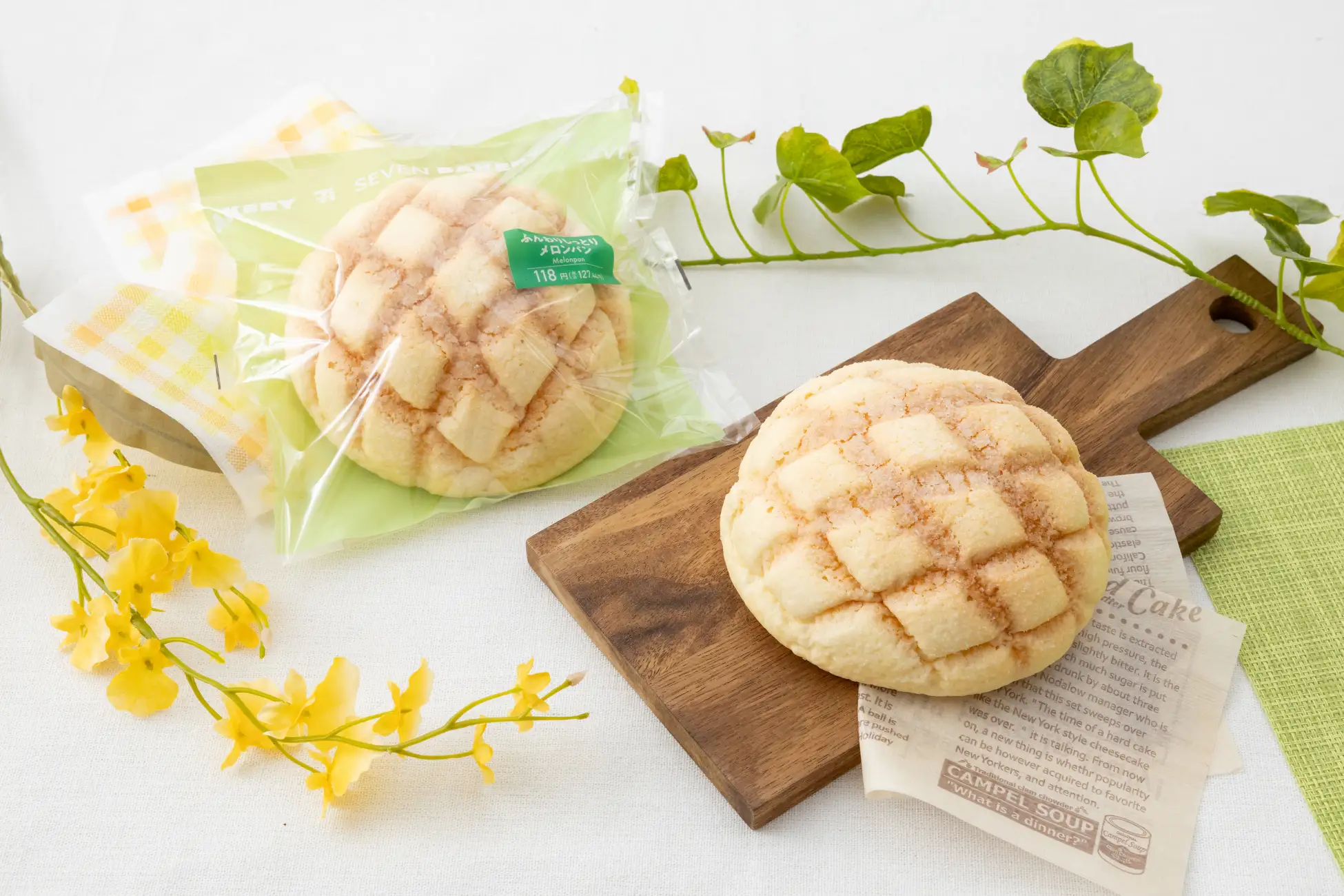
A familiar bun in Japan’s convenience-store bread aisle is getting a little more substantial. 7-Eleven Japan will begin selling Funwari Shittori Melon Pan (ふんわりしっとりメロンパン) — roughly, “soft and moist melon bread” — on October 13, 2026, at stores nationwide except in Okinawa. The listed price is ¥127.44, including tax.
The update centers on melon pan’s defining contrast: a crisp, sweet shell and soft bread underneath. In its announcement on October 7, 2026, the company said it had increased the total amount of dough by 10 percent and revised both the recipe and the baking process.
A different flour blend is intended to give the outer layer a lighter, crisper bite. The company has also increased the granulated sugar and adjusted the butter aroma. Changes to the baking process help the bread rise more fully, making the interior softer and fluffier.
It is a modest revision to an everyday staple, with more dough and a sharper contrast between crust and crumb. Prices and availability may vary by store.
Melon pan(メロンパン) is a Japanese sweet bun with two distinct parts: soft bread dough and a cookie-dough covering that forms a crisp shell in the oven. The surface is often scored with a crisscross pattern.
The name can mislead a first-time buyer. Traditional melon pan does not taste of melon. Its name is commonly attributed to its rounded shape and patterned crust, which resemble the fruit. Pan means bread in Japanese.
Think of a butter cookie wrapped around a lightly sweet bread roll. Eggs and butter give it richness; sugar adds sweetness and, as the crust bakes, a warm, toasted aroma. The shell breaks under the first bite, giving way to the tender bread beneath.
Chocolate chips, cream fillings and actual melon flavor appear in some versions. The classic bun needs little embellishment: its appeal rests on that sweet, buttery crust and the soft crumb inside.
Melon pan occupies a familiar place among Japan’s everyday sweet comforts. It is satisfying, inexpensive and easy to find — in neighborhood bakeries, supermarkets and the bread aisles of convenience stores. Those qualities have helped sustain its appeal across generations.
At 7-Eleven, which began selling melon pan in 1991, sales exceeded 44 million buns in 2024. That is one chain’s tally, but it gives a sense of the appetite for this unassuming staple.
The history of melon pan is harder to pin down. One account credits Ivan Sagoyan, an Armenian baker, with making a predecessor at Tokyo’s Imperial Hotel in 1910, using European baking techniques. Another points to a Tokyo baker who registered a method for covering bread dough with cake dough in 1930. A third identifies a round, biscuit-topped bun sold as “Sunrise” in Kure, Hiroshima Prefecture, during the 1930s. Other theories look abroad, to Mexico’s concha or Germany’s streuselkuchen, arriving by way of the United States. No single account has settled the question.
Even the name changes with geography. In parts of western Japan, including areas of Kansai and the Seto Inland Sea region, the round bun is known as Sunrise(サンライズ). There, “melon pan” can mean an elongated bun, sometimes filled with sweet white bean paste.
The pairing of soft bread and a sweet crust has relatives elsewhere. In Mexico, the concha takes its name from the seashell-like pattern on its sugary topping. Hong Kong’s pineapple bun, or bolo bao (菠蘿包), has a golden, crackled surface that suggests pineapple skin. Like traditional melon pan, it generally contains none of the fruit in its name.
Hong Kong’s “Mexico bun” (墨西哥包) offers a more clearly traceable connection to the concha. Reports by Zolima CityMag and PBS link it to the Ng family, who had lived in Mexico before coming to Hong Kong. According to Zolima CityMag, they opened a café on Shanghai Street in 1946 and created the bun as a tribute to the concha. Some accounts also suggest that the Mexico bun helped give rise to the pineapple bun, though that lineage remains uncertain. The Mexico bun became a local bakery staple, carrying a small piece of that migration story in its name and sweet crust.
South Korea’s soboro bread (소보로빵) follows a similar principle, with a crumbly, streusel-like topping often made with peanut butter. The recipes differ, but the pleasure is familiar: soft bread beneath a sweet topping, with enough contrast to make each bite interesting.